I did not set out to create content that resonates with more than 216,000 people.
I sat down and wrote a Kung Fu Panda movie review because I wanted a creative outlet.
It reached:
— 23k likes
— 188 comments
— 817 new followers
And the numbers are still rising.
The Post Was Never Meant to Convert
Did it bring food to my table?
No.
Did it generate inquiries for my social media services?
Also no.
Because it wasn’t meant to.
It was a creative outlet.
I wasn’t trying to create a lead magnet.
I wasn’t trying to strategize for conversions.
I just sat down and wrote about Kung Fu Panda characters (Tai Lung, Tigress, Po, and Shi Fu).
A few days and weeks later, it had reached over 216k people.
The Comments Were Not Really About Kung Fu Panda
But in the comment section, people weren’t really talking about Kung Fu Panda.
They were talking about something else:
— gifted child syndrome
— performance-based self-worth
— conditional love received as a child
— trauma and coping mechanisms
Someone even mentioned Carl Rogers and I had to Google him.
Others debated whether Tai Lung would’ve turned out differently if Shifu had raised him differently.
But I don’t think most people were talking about Kung Fu Panda.
I think they were talking about themselves.
And that’s not a bad thing.
Stories Help People Understand Themselves
Stories have always been one of the safest ways for people to explore parts of themselves they don’t yet have words for.
A movie about a panda learning kung fu became a conversation about identity, belonging, expectations, and worth.
Which reminded me of something I often see working behind the scenes as a social media strategist:
People spend a lot of time asking what format works on what platform.
Should this be a video?
A carousel?
A text post?
Should it go on TikTok, LinkedIn, or Instagram?
Because a lot of us still treat platforms as if they have their rigid rules
— TikTok is for short videos
— Instagram is for pretty posts
— LinkedIn is for professional insights
But people don’t just engage with content formats.
Why Content That Resonates Goes Beyond Format
Content that resonates gives people a way to understand something about themselves, regardless of the platform or format used to deliver it.
They engage with ideas that help them understand something about themselves.
The post resonated because it wasn’t really about a movie.
It was about being a human and relating to a story.
It didn’t matter that it was a text-filled 16-slide carousel post on TikTok.
Because while the topic was Kung Fu Panda, the real subject was identity.
That’s what people connected with.
Ironically, I forgot to delete the last draft slides before publishing.
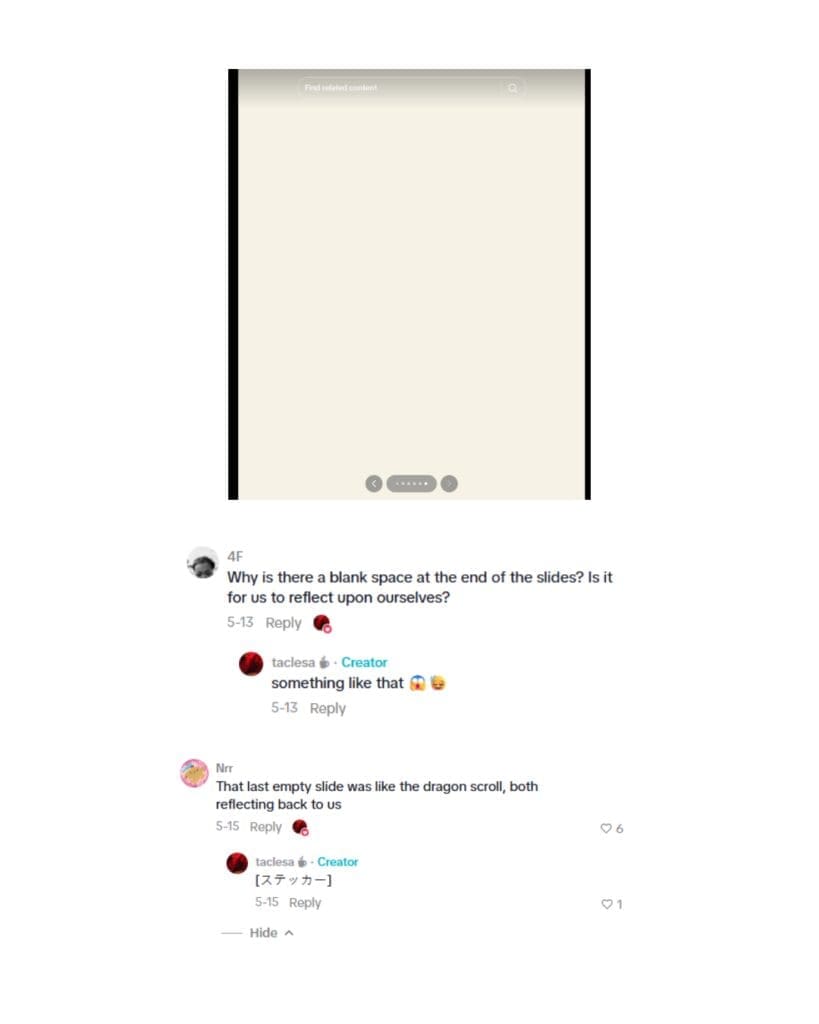
One was the caption notes.
Another one was a blank slide.
People started interpreting the blank slide as the Dragon Scroll.
“The secret ingredient is that there is no secret ingredient.”
They found meaning in a mistake.
Which is another reminder that audiences are often more thoughtful than marketers (including myself) give them credit for.
Ask What Conversation You Are Inviting People Into
We spend a lot of time asking,
— “What time should I post?”
— “What trendy song should I add to this post?”
— “What hook should I write to catch attention?”
— “Where should I post this?”
The better question is,
“What conversation am I inviting people into?”
Because if the idea resonates deeply enough, people and algorithms will meet you there, regardless of the content format or platform.
My post did not reach 216,821 views simply because it was a movie review.
It became content that resonates because somewhere inside a story about animated animals, people found pieces of their own stories too.