

You know your business.
You can answer client questions without checking your notes. You have opinions about your industry. You have stories, lessons, processes, and years of experience behind the work you do.
Then it is time to post on social media, and somehow you have absolutely no idea what to say.
You open your Notes app.
You scroll through old drafts.
You check what other people in your industry are posting.
Forty-five minutes later, you have three possible hooks, six open tabs, and no actual post.
I have seen versions of this problem across business owners, thought leaders, creatives, therapists, authors, and service providers.
The lack of expertise is rarely the issue.
The harder part is recognizing which piece of that expertise deserves to become content and deciding how to structure it.
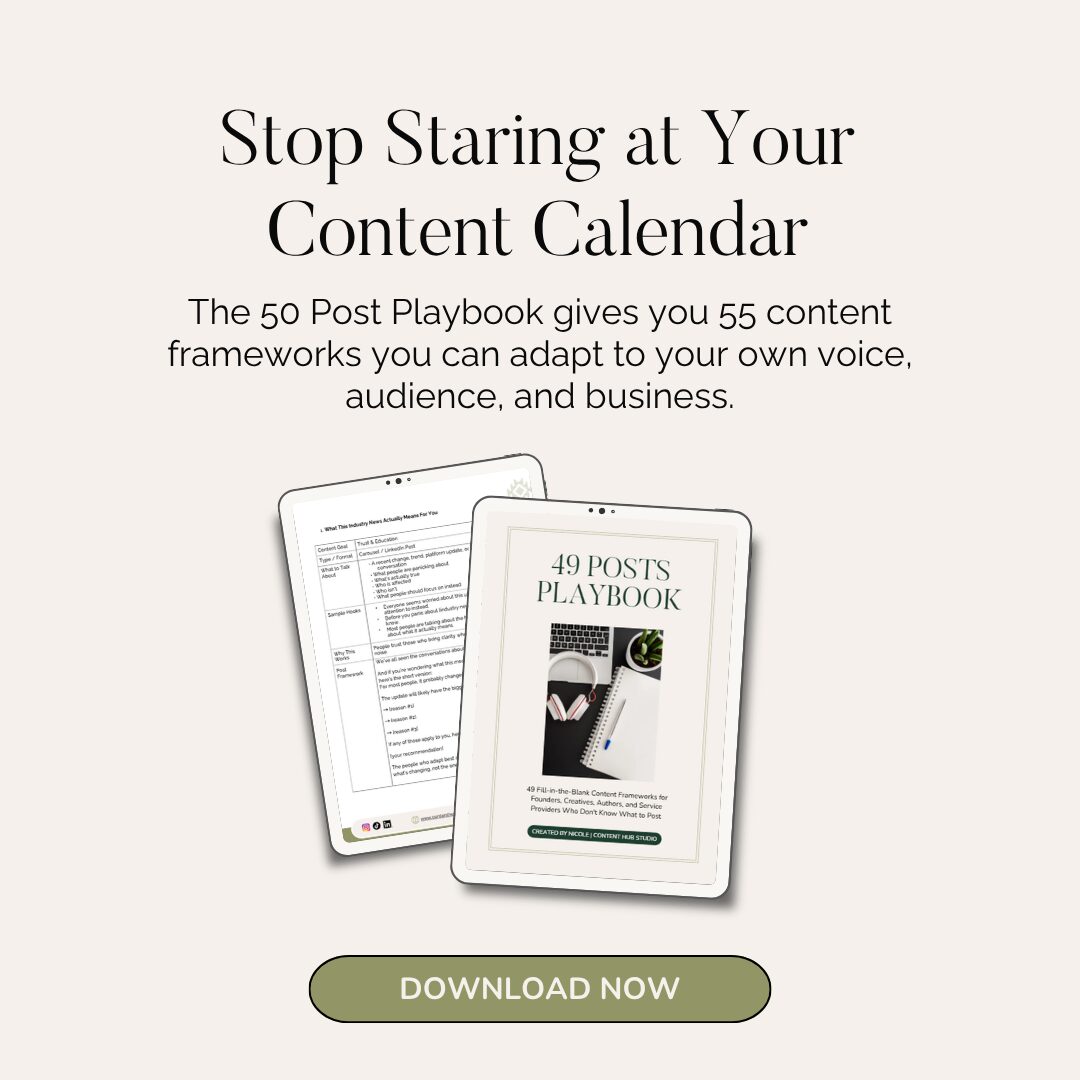
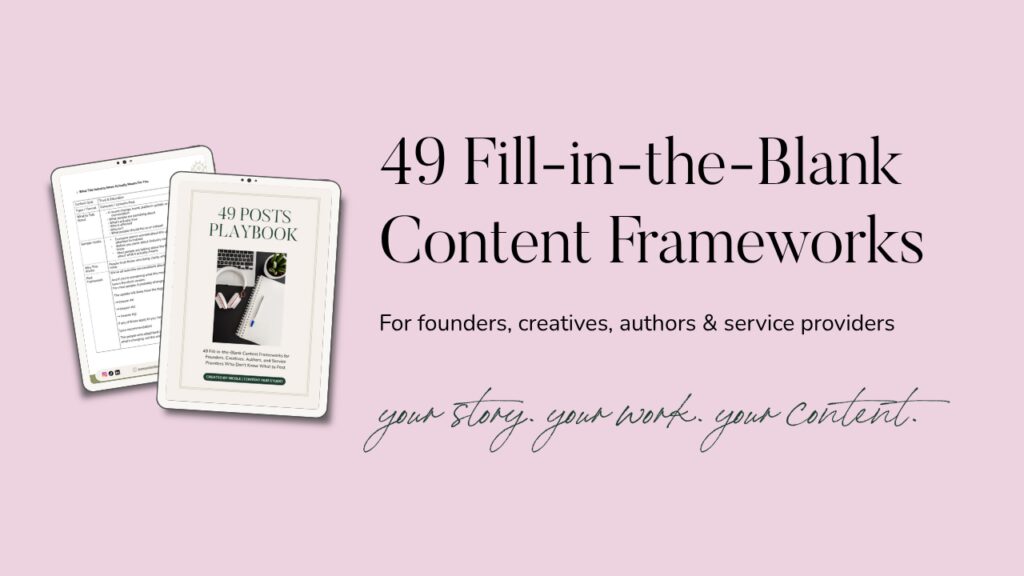
That is why I created the 49 Posts Playbook.
You probably have more content ideas than you realize
One of the strange things about expertise is that the more familiar you become with a subject, the harder it can be to see what is interesting about what you know.
A therapist may answer the same question during consultations every week and never think to turn the answer into a post.
A founder may have a strong opinion about a common practice in their industry but dismiss it because it feels obvious.
An author may have pages of notes about storytelling, character development, and their creative process, yet sit down to create social media content and decide they have nothing to share.
You are close to your own knowledge.
You know the background. You understand the nuance. You have already made the connections.
Your audience has not.
This creates a recognition problem.
You keep looking for a completely new content idea while sitting on years of questions, observations, experiences, and opinions that could already become content.
The challenge is finding a useful way into them.
A blank content calendar creates too many decisions at once
“Decide what to post” sounds like one task.
It rarely is.
You are deciding what topic to discuss.
Then you have to decide which part of the topic matters.
You need an angle.
You need a hook.
You need to work out whether the idea should become a carousel, video, text post, or something else.
Then you start wondering whether the post is useful enough, original enough, professional enough, or relevant enough.
This is why people can have an entire folder of ideas and still feel stuck.
The mental load is happening before the writing really begins.
A blank page gives you unlimited options.
Unlimited options are not always helpful when you already have a business to run.
Sometimes you simply need a strong starting point.
The 49 Posts Playbook gives you somewhere to start
I created the 49 Posts Playbook for the days when you know you need to create content but do not want to build the entire idea from the ground up.
Inside are 49 fill-in-the-blank content frameworks for founders, creatives, authors, and service providers.
These are organized around five jobs your content may need to do:
- Build trust
- Attract the right audience
- Become memorable
- Generate inquiries
- Help you post something when you genuinely have no idea what to post
This matters because “What should I post?” is usually too broad a question.
I would rather ask:
What does your content need to do right now?
Perhaps your audience needs to understand your expertise more clearly.
Perhaps you need more content that shows how you think.
Perhaps people follow you but still do not understand what it would be like to work with you.
Perhaps you have had an exhausting week and simply need one useful idea that keeps your account active without requiring a two-hour internal strategy meeting.
The answer changes the type of content I would create.
That is the thinking behind the playbook.
Each framework helps you develop the idea, not just name a topic
I have downloaded enough content idea lists to know the frustration of reading:
Share a lesson you learned.
Okay.
Which lesson?
How do I open the post?
What part of the story matters?
Why would my audience care?
What am I supposed to do with this idea now?
A topic is not always enough.
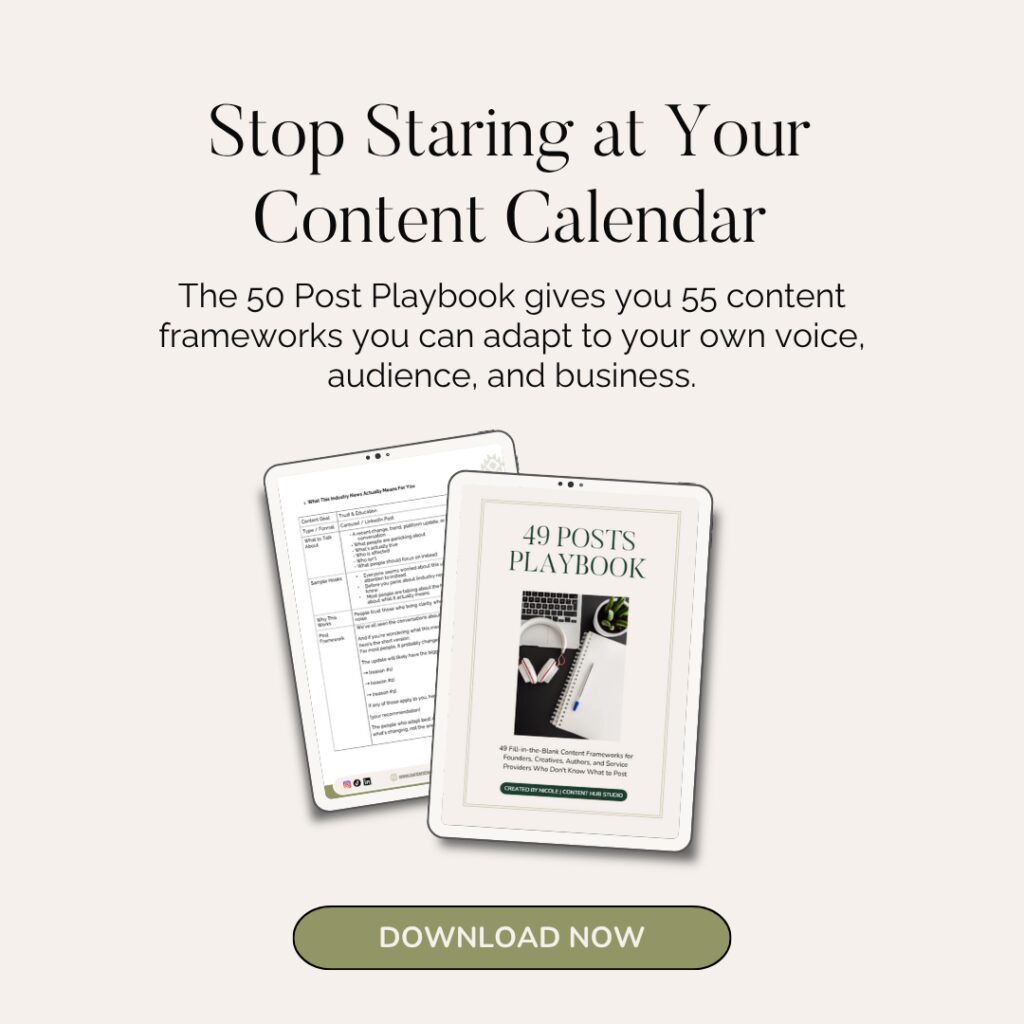
So each framework in the 49 Posts Playbook includes:
— A content goal so you understand the role of the post.
— A recommended format to give the idea a practical direction.
— What to talk about so you can identify the right material from your own experience or expertise.
— Sample hooks to help you find an opening angle.
— Why the format works so you understand the thinking behind the post.
— A fill-in-the-blank post framework that gives you a structure to build from.
For example, one framework is:
5 Things People Get Wrong About [Topic]
Instead of leaving you with the title and wishing you luck, the framework prompts you to think about common misconceptions, advice you disagree with, assumptions clients make, and industry myths.
It gives you possible hooks.
It explains the strategic value of correcting misconceptions.
Then it provides a structure you can adapt using your own knowledge.
You are still the expert.
The framework helps you find a clearer route into what you already know.
You are not supposed to copy the frameworks word for word
I want to be very clear about this because the internet does not need 700 people posting the exact same caption with different nouns inserted into the brackets.
The frameworks are starting points.
Take the structure.
Add the question your clients actually ask.
Use the opinion you genuinely hold.
Include the lesson you learned after years in your field.
Change the wording.
Delete the parts that do not sound like you.
The goal is to reduce the number of decisions standing between your expertise and the finished post.
Your stories, experience, judgment, and perspective are still what make the content yours.
A framework cannot manufacture expertise.
It can help you communicate the expertise you already have.
This playbook is especially useful when you tend to overthink content
There are people who can think of an idea, record a video in three minutes, post it, and continue with their day.
I respect them deeply.
This playbook was probably created for the rest of us. 😂
The people who can see six possible angles in one idea.
The people who rewrite the first sentence nine times.
The people who worry that simplifying something will make it inaccurate.
The people who have years of knowledge and somehow feel like every post needs to contain all of it.
The people who open Instagram for “content inspiration” and emerge questioning their entire business positioning.
You may still think deeply about your content.
That is often a strength, especially when your work requires care, nuance, or professional judgment.
You simply need a way to stop making every post an entirely new strategic problem.
That is where frameworks become useful.
They reduce the amount of content architecture you have to rebuild every time you sit down to write.
You can also use the playbook based on what your content is currently missing
Sometimes the problem is deeper than running out of ideas.
You may have plenty of educational content, but very little that helps people remember your perspective.
You may post consistently, but rarely explain what you actually help people with.
You may have a knowledgeable audience that trusts your expertise but still does not know when to inquire.
This is why I organized the playbook by purpose.
If your content needs to demonstrate expertise, start with the Building Trust section.
If your account feels disconnected from the people you actually want to reach, explore Attracting the Right Audience.
If your content is accurate but forgettable, look at Becoming Memorable.
If people engage with your posts but rarely move closer to your services, start with Generating Inquiries.
And when your brain is simply full, busy, or unwilling to produce one more profound thought for Instagram, go directly to When You Have No Idea What to Post.
You do not have to create content in page order.
Pick the problem you are trying to solve.
Then choose a framework.
The playbook gives you 49 starting points. Your expertise gives them depth.
This is the part of content creation that gets lost when people keep searching for more ideas.
A content idea only becomes useful when it meets something specific from your work.
Your experience with a client problem.
The question you have answered 30 times.
The industry advice you quietly disagree with.
The process you have refined over several years.
The mistake that changed how you work.
The concept you explain differently because you know where beginners usually get confused.
Those are the things I look for when developing content around an expert or business.
The 49 Posts Playbook gives you 49 ways to start looking for them yourself.
You may open one framework expecting to write a single post and realize you have five different examples you could use.
You may find an old blog that suddenly fits a framework.
You may remember a client question you had dismissed as too basic.
You may finally see why the draft sitting in your Notes app never felt finished. The idea was there. It needed a stronger angle and structure.
That is what I hope this playbook makes easier.
Get the 49 Posts Playbook
You do not need another folder full of generic content prompts you forget about after three days.
You need something you can open when the content calendar is blank and your brain is already doing enough.
The 49 Posts Playbook includes 49 fill-in-the-blank content frameworks designed to help you build trust, attract the right audience, become more memorable, generate inquiries, and keep creating when you have absolutely no idea what to post.
Each framework gives you the idea, possible hooks, strategic reasoning, and a structure to adapt using your own expertise.
The playbook is $29.
Pick a page. Steal an idea. Add your expertise. Make it yours.
And when you reach the point where you no longer want to manage the content planning, strategy, writing, and execution yourself, that is the work I help with at Content Hub Studio.
You bring the expertise.
I find the content inside it and build the system around it.


